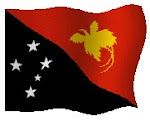
ORO..ORO..ORO!! (Oro means "Welcome" in the languages of the Northern Province of Papua New Guinea). The word conjures up images of graceful dancing warriors adorned with flamboyant headdress made from Bird of Paradise feathers and hornbill beaks, jabbing spears into the air, chanting "Oro...Oro..Oro" to visitors. With the same passion, I say "Oro..Oro..Oro" to you. Stories of my village Begabari, my province (Northern/Oro) and my beautiful country, Papua New Guinea will feature here.
A legislative framework will be designed to safeguard the proposed LNG Sovereign Welfare Funds from political manipulation and pilfering, the Government said yesterday (according to Post-Courier Business News).
The Australian government will play a major role in helping PNG design a legal regime that would govern management of the fund, a spokesman of the Department of State Entreprises said in response to a series of questions from the media.
" The crux of the overseas aid problem appears at first to be
hopelessly complex and difficult to understand. However maybe this is
not really so. All one has to do is to break the problem down into the
composite parts.
Firstly, why are there any overseas aid programs anyway? Here are a few reasons:
1. Influence – obtaining prestige on the world stage – PM Rudd
(previous diplomat) is currently trying to achieve this by upping the
aid program to gain acceptance and an ego trip on the world diplomatic
stage. His last attempt to do this with the Copenhagen conference of
climate change flew like a proverbial lead zeppelin. Hence he is now
flying the overseas aid flag to try and get African states to assist in
him getting a temporary seat on the UN Security Council. Who cares?
Very few Australians that’s for sure. Yet the PNG PM is saying that his country will be a donor country. Go figure, as the ‘skeptics’ say.
2. National Security and Economic Gain – Humankind is very
predictable and as each civilisation expands it seeks to excludes others
who are in competition with it. This contest may be by open warfare but
is usually carried out using economic influence and will include
competition for natural resources. Look at the mining and timber
industries in PNG as examples. Aid programs are often tailored with
this aspect in mind.
3. Guilt – Some leaders of some less developed countries have
perfected a very useful method of extracting free money from those
developed countries who are considered ‘fair game’. This gives rise to
the scenario where the erudite African despot and his secret police are
living very well off the aid sent by donor countries who are appalled
by the conditions in the despot’s country and want to help. With no
freedom of the press and repressive policing, no one except the
dictator really knows what goes on in his country and the aid program
pays for the PR team (usually made up of overseas consultants who must
keep the money rolling in to be paid, and therefore in order to keep
the status quo going. Of course, this would never happen in PNG would
it?
4. Genuine concern – The high moral ground must be taken by the NGO
and Church groups who actually do achieve something, usually with very
limited funding and volunteer staff. Not all missions in PNG are useful
and some missionaries can be most unhelpful based on my direct
observation.
5. Demand – Less developed countries are often lured into accepting
aid money as a practical way of becoming more developed. This is a myth
and almost every country that has become developed has done so without
overseas aid assistance. What has overseas aid to PNG achieved over the
last 35 years?
So what yardstick do you use to evaluate the aid program? Surely
that should be assessed in long term benefits to the country receiving
the aid? Wrong! Why? Because the donor countries get wound up in a
never ending cycle of continually giving more because the very aid they
give makes those receiving it more and more dependent."
There are calls for a major overhaul of Australia's $400 million
aid program in Papua New Guinea, after a review concluded more than half of the
money was spent on "technical assistance".
Australia is PNG's biggest aid donor and the joint review of the
PNG-Australia Development Treaty says there have been some successes, like
improving roads and tackling the HIV-AIDS epidemic.
But it has found widespread dissatisfaction in both countries and says the
status quo cannot continue.
Australia's aid agency AusAID has been heavily criticised recently amid
revelations it is paying some consultants six-figure tax-free salaries to
provide technical assistance.
The review says overall the practice has made little difference to life in
PNG and this method of capacity building does not work.
The review found Australian aid was being spread too thinly across too many
areas and recommended a focus on improving education.
It recommends a reduction in the amount of money spent on technical
assistance and says AusAID could do more to reduce the cost of hiring
consultants.
The review also says non-government organisations - such as church groups
and the health sector - should be given a greater role in delivering aid.
World Vision Australia chief executive Tim Costello says non-government aid
organisations are better equipped to help Papua New Guinea.
"What we know about effectiveness in aid is that it is always about
relationships, staying there a long time, winning the community trust, getting
to the poorest and most vulnerable - not the fly in, fly out high-level stuff
that's happening," he said.


 Posts
Posts